Question
Describe the structure of the cell membrane and how it relates to the intra-and extracellular fluid.
Answer
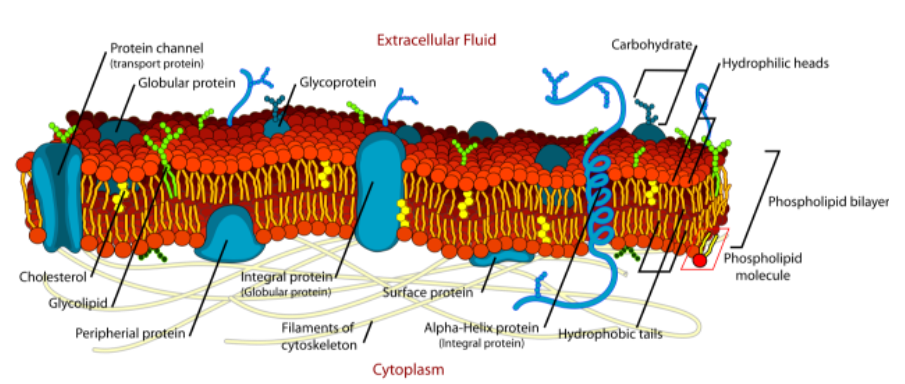
The simplest way to describe the cell membrane is as a phospholipid bilayer. Bilayer means 2 layers, and there are 2 layers of phospholipid molecules in the cell membrane. The term phospholipid refers to the structure of the molecule-it is made up of a phosphate head and 2 lipid tails. The phosphate head is negatively charged (so can be described as polar) which makes it hydrophilic (hydro-refers to water and -philic means loving). The phosphate head wants to be in contact with water so it faces the intracellular in the extracellular fluid. The lipid tails are uncharged (nonpolar) which makes them hydrophobic. This means that they don't want to be near water. They are located in the centre of the bilayer. The chemical and physical characteristics of the bilayer makes it a semipermeable membrane. This means that some things can pass through it easily whereas others cannot. The molecules that can pass freely through the cell membrane are lipophilic (which means water soluble molecules are unable to pass directly-the membrane is impermeable to these molecules). Another name for the cell membrane is the plasma membrane.